


Executive Summary
The AI industry currently faces a definitional crisis regarding “agents.” While the term is applied broadly to a $6 billion industry, major labs like Anthropic noted in 2026 that there is still no consensus definition. This ambiguity leads to confusion between highly autonomous systems and prescriptive, scripted workflows.
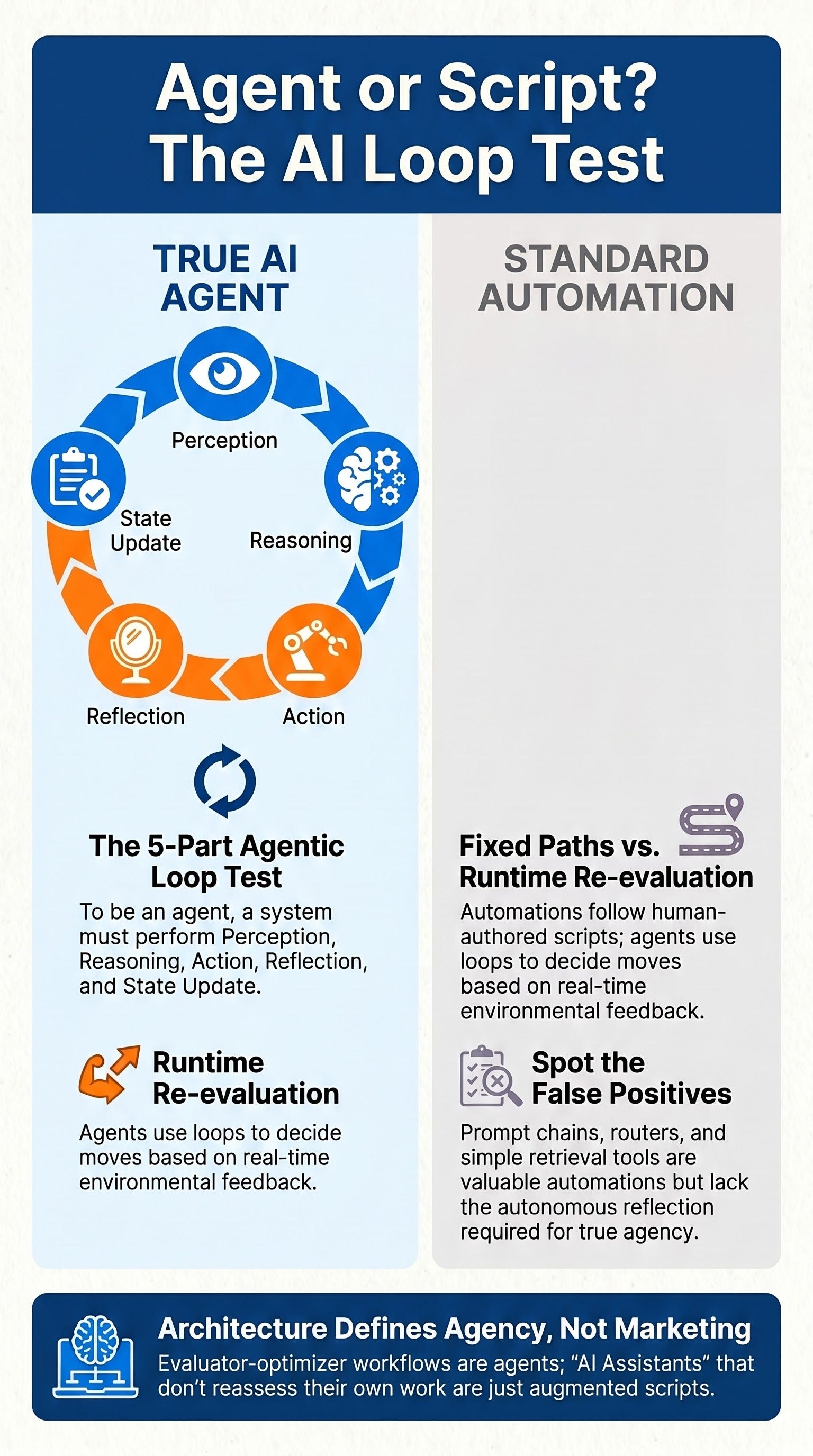
This document synthesizes a strict, operational “Loop Test” to distinguish genuine agentic workflows from standard automation. The core distinction is architectural: in a true agentic workflow, the world after action is part of the computation, not a byproduct of it. While many systems—such as prompt chains, routers, and retrieval assistants—are marketed as agents, they often fail this test because they follow predefined paths rather than re-evaluating their state based on the results of their actions. Understanding this distinction is critical for builders to create systems capable of recovering from environmental surprises and mismatches between intention and outcome.
--------------------------------------------------------------------------------
The Definitional Crisis in AI Agency
The current landscape of AI development is marked by a significant gap between marketing language and engineering reality.
The Anthropic Admission: Even as late as 2026, leading AI labs admit that “agent” is used interchangeably for both highly autonomous systems and prescriptive workflow implementations.
Framework Divergence: Major frameworks prioritize different aspects of agency:
LangChain: Focuses on the combination of LLMs and tools to reason and work iteratively until a stop condition.
OpenAI: Emphasizes the central role of the “while loop.”
Pydantic AI: Focuses on typed containers, reflection, and self-correction.
The No-Code Influence: Platforms like n8n, Zapier, and Make have integrated “AI Agent” branding into their product categories, further blurring the line between deterministic graphs and autonomous loops.
--------------------------------------------------------------------------------
The Five-Part Operational Test for Agents
To move beyond “aesthetic” definitions, an architectural test is required. A system is considered an agent if it successfully implements the following five components:
Component
Definition
Requirement for Agency
Perception
Acquiring state from outside the system.
Reading tool outputs, filesystem states, or API responses—not just continuing a static prompt.
Reasoning
Deciding the next move based on current state and objective.
Decisions must be selected in context, not following a “Step B follows Step A” script.
Action
Affecting or probing the environment.
Producing a consequence that changes or reveals external state (e.g., calling an API, querying a DB).
Reflection
Examining resulting evidence and reassessing progress.
Asking if the action achieved the goal and deciding whether to retry, pivot, or finish.
State Update
Incorporating reflection into the next cycle.
The results of reflection must meaningfully alter what happens next.
The Fundamental Principle: If a system does not look at the result of its own action to decide its next move, it is a script, not an agent.
--------------------------------------------------------------------------------
Agentic Workflows vs. Automation Workflows
The distinction between a standard automation workflow and an agentic one lies in who “owns” the loop.
Automation Workflows (Scripts): These are collections of connected nodes where a human designer authors the path in advance (e.g., standard n8n, Zapier, or Make flows). Even if an LLM is a step in the flow, it is performing a task within a larger, deterministic script.
Agentic Workflows (Loops): The human defines the goal, the tools, and the evaluation criteria. The system then decides the path at runtime through continuous re-evaluation.
The n8n Nuance
While standard n8n canvas workflows are typically deterministic orchestration, specific nodes—like the n8n AI Agent node—can contain a genuine agent loop. Agency can exist at the node level even if the surrounding environment is a fixed script.
--------------------------------------------------------------------------------
Analysis of “Agentic” Failure Modes
Many systems casually labeled as “agents” fail the reflection-centered loop test. These are categorized as augmentations or prescriptive workflows rather than agents.
The Prompt Chain: One model call feeds the next with optional gates. While this improves accuracy, the path is predefined; there is no model-owned action-selection loop.
The Router: An LLM chooses a branch to execute. However, once the route is chosen, the subsequent path is authored ahead of time. Classification is a dispatch mechanism, not reflection.
Trigger-Action Automation: Common in no-code patterns where an LLM summarizes or classifies a trigger, but the rest of the graph is a static script.
Retrieval Assistants: Systems that use tools to fetch documents but do not autonomously continue the loop based on results. These are better described as “augmented LLMs.”
--------------------------------------------------------------------------------
Surprising Passes: Agency Without the Label
Conversely, some systems satisfy the architectural requirements of agency even if they are not marketed as such.
Evaluator-Optimizer Workflows: Anthropic classifies these as “workflows,” but because they generate, evaluate, and loop back based on that evaluation, they are structurally agentic.
Software “Demons” (Daemons): Background processes (e.g., email-icon daemons) that monitor environments, detect state changes, and take autonomous actions to meet design objectives. They represent a minimal, non-LLM closed loop.
Embedded Agent Nodes: A genuine agent loop residing inside a deterministic orchestration platform (like n8n’s AI Agent node).
--------------------------------------------------------------------------------
Conclusion: The Architecture of Recovery
The debate between a “spectrum” view of agency and a “binary” test serves different purposes. While agency is descriptively a spectrum (varying in autonomy and duration), the binary architectural test is more useful for builders.
The primary purpose of a loop is to allow a system to recover when the world surprises it. A system that lacks reflection will fail in a “script-like” way when intentions and outcomes mismatch. Therefore, the essence of agency is not aesthetic or based on the presence of an LLM; it is architectural—defined by whether the world after action is folded back into the computation for the next decision.


