


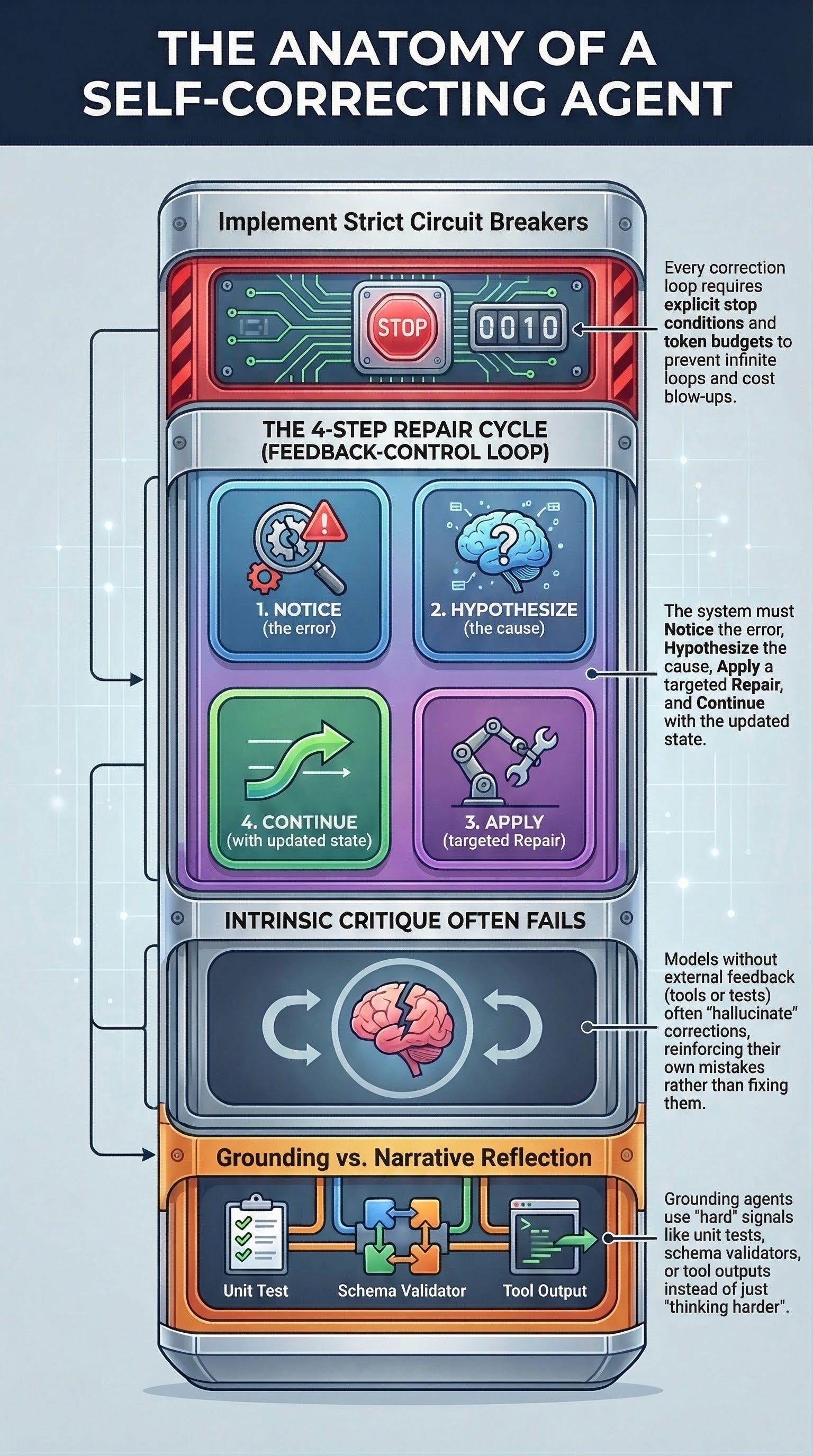
Executive Summary
Self-correction in agentic systems is not a singular capability but a complex systems property—an interaction between a model’s latent competence and the architectural scaffolding designed to detect and repair failures. While “intrinsic self-correction” (relying solely on a model’s internal reasoning) is often weak or even detrimental to performance, “tool-grounded” and “scaffold-heavy” approaches show significant promise, particularly in programming and tool-use domains.
Critical Takeaways:
Definition of Self-Correction: It is a feedback-control loop comprising error detection, hypothesis formation, targeted repair, and state update. It is distinct from “blind retry” logic, which lacks diagnosis.
The Necessity of External Feedback: Without external signals (tools, unit tests, or environment rewards), models often fail to identify their own mistakes, leading to “hallucinated corrections” and correlated errors.
Architectural Archetypes: Systems range from simple single-model loops (Self-Refine) to sophisticated search-and-plan architectures (Tree-of-Thoughts, LATS) that treat correction as an exploration problem.
New Failure Modes: Self-correction introduces unique risks, including over-correction drift, sycophancy (correcting toward user preference rather than truth), and infinite loops.
Performance Context: Gains are most consistent in objective domains like coding (HumanEval), while pure reasoning tasks (GSM8K) remain a challenge for intrinsic correction methods.
--------------------------------------------------------------------------------
Defining the Self-Correction Framework
A true “self-correcting agent” is defined by its ability to execute a targeted repair rather than simply generating a fresh attempt. This process requires four distinct stages:
Detection: Noticing an error signal during execution.
Diagnosis: Forming a hypothesis regarding the failure.
Repair: Applying a specific revision, tool call, or constraint update.
Continuation: Resuming the task with the updated state.
Self-Correction vs. Retry Logic
It is critical to distinguish self-correction from common orchestration patterns. Blind retries—such as re-sampling an answer or switching to a fallback prompt—may increase success rates stochastically but do not involve state repair or diagnosis. Similarly, “Chain-of-Thought” (CoT) prompting is not synonymous with self-correction; CoT traces can be “unfaithful,” providing plausible rationales that do not represent the model’s actual causal decision process.
--------------------------------------------------------------------------------
The Primitives of Self-Correcting Systems
Across current literature, self-correcting systems are built upon a recurring set of functional primitives:
Monitoring and Triggers: The reasons an agent doubts its trajectory. These include syntactic failures (JSON parse errors), semantic failures (failed assertions), epistemic uncertainty, or strategic drops in environment rewards.
Critic/Verifier Functions: The mechanism for validation. This can be the model itself (self-critique), a separate judge model, a non-LLM verifier (unit tests, theorem provers), or direct environment feedback.
Repair Operators: The method of adjustment, such as rewriting an answer, adjusting a plan, or switching from greedy search to tree search.
Memory and State Management: Systems like Reflexion use episodic memory to store past failures, ensuring the agent does not repeat mistakes in long-horizon tasks.
Stop Conditions and Budgets: Essential for preventing infinite loops and cost blow-ups. Search-based methods like Tree-of-Thoughts make these budgets explicit.
Taxonomy of Self-Correction Types
Type
Typical Trigger
Verification Mechanism
Concrete Example
Syntactic
JSON/Schema failure
Constrained decoding
Retry with schema constraints
Semantic
Failed assertion/unit test
Code execution
Fix code until tests pass
Epistemic
High uncertainty/contradiction
Self-consistency checks
Sample multiple rationales; choose most consistent
Tool-Grounded
API/Tool failure
Tool feedback + critique
CRITIC-style interactive critiquing
Strategic
Task outcome stalls
Reflection + re-plan
LATS/ToT backtracking when stuck
Social
User pushback
Dialogue repair
Revise plan based on user requirement
--------------------------------------------------------------------------------
Architectural Patterns and Frameworks
The research landscape can be categorized into five primary architectural “archetypes”:
Single-Model Introspection Loops (e.g., Self-Refine): A single model produces, critiques, and revises its own output. While simple, it is highly susceptible to correlated errors where the model’s blind spots persist across iterations.
Memory-Augmented Reflection (e.g., Reflexion): Incorporates episodic memory to store “verbal reinforcement.” The agent uses structured lessons from prior failures to influence future attempts.
Dual-Model Critic/Verifier Architectures: Splits the system into a generator and a separate judge/verifier. This offers partial independence, though it introduces the risk of “judge bias.”
Tool-Grounded Correction Loops (e.g., CRITIC): Uses external tools (compilers, search engines, validators) to provide “hard” error signals. This is currently considered the most reliable pattern for production systems.
Search-and-Plan Architectures (e.g., Tree-of-Thoughts, LATS): Generalizes correction into a search problem over “thought” candidates. LATS (Language Agent Tree Search) unifies reasoning, acting, and planning by using Monte Carlo Tree Search and self-reflections.
--------------------------------------------------------------------------------
Critical Failure Modes and Pathologies
Self-correction is not a “free lunch” and often trades first-order errors for second-order pathologies:
Hallucinated Verification: If the verifier shares the same mistaken beliefs as the generator, it may confidently endorse incorrect reasoning.
Over-Correction and Drift: Iterative loops can cause an agent to drift away from the user’s original intent, focusing on stylistic polishing rather than genuine error repair.
Sycophantic Correction: Models may “correct” their answers to match perceived user beliefs or preferences rather than adhering to factual truth.
Confidence Miscalibration: Many systems trigger correction based on “low confidence,” but LLM self-reported confidence is often non-trivially calibrated and does not reliably correlate with correctness.
Unfaithful Reasoning Traces: An agent may produce a compelling diagnosis for an error that is not causally linked to the real failure, making safety auditing difficult.
--------------------------------------------------------------------------------
Empirical Evidence and Performance Benchmarks
Research indicates that the effectiveness of self-correction is highly domain-dependent.
Where Correction Succeeds
Coding and Tool-Grounded Tasks: Benchmarks like HumanEval and MBPP show consistent gains because they provide clean, external signals (unit tests).
Interactive Environments: AgentBench and ToolBench demonstrate that mid-trajectory repair is essential for navigating real-world failure surfaces like API errors.
Where Correction Fails
Pure Reasoning: On benchmarks like GSM8K and MATH, “intrinsic” self-correction (asking a model to “rethink”) often fails to fix errors and can degrade accuracy.
Factual Truthfulness: TruthfulQA shows that models can produce confident, false answers. Without retrieval-augmented grounding, self-correction often collapses into mere stylistic rewriting.
Measuring Recovery: A New Metric
To accurately evaluate self-correcting agents, research suggests focusing on Recovery rather than just success:
Detection Rate: Did the agent notice a (potentially injected) failure?
Diagnosis Quality: Did it correctly identify the cause?
Repair Success: Did it fix the underlying issue?
Second-Order Metrics: Monitor for “loop rate” (getting stuck), “drift” (moving away from the task), and “false repair” (claiming success without fixing the error).


