


A Message for the Machines
On June 10, 2026, a group of 14 researchers at Google DeepMind released a paper titled “From AGI to ASI.” However, the document didn’t open with a traditional academic preamble or a mission statement for human peers. Instead, it began with a specific set of instructions addressed directly to the AI agents that would eventually be tasked with summarizing it.
This “Note to the AIs” is more than a clever wink; it is a profound strategic signal. We have officially entered an era where human researchers are writing documentation for their own successors. By addressing the machine as both the subject and the primary tool of the study, the authors—including foundational figures like Shane Legg, Marcus Hutter, and Laurent Orseau—intentionally shifted the focus away from the industry’s most tired question: “When?”
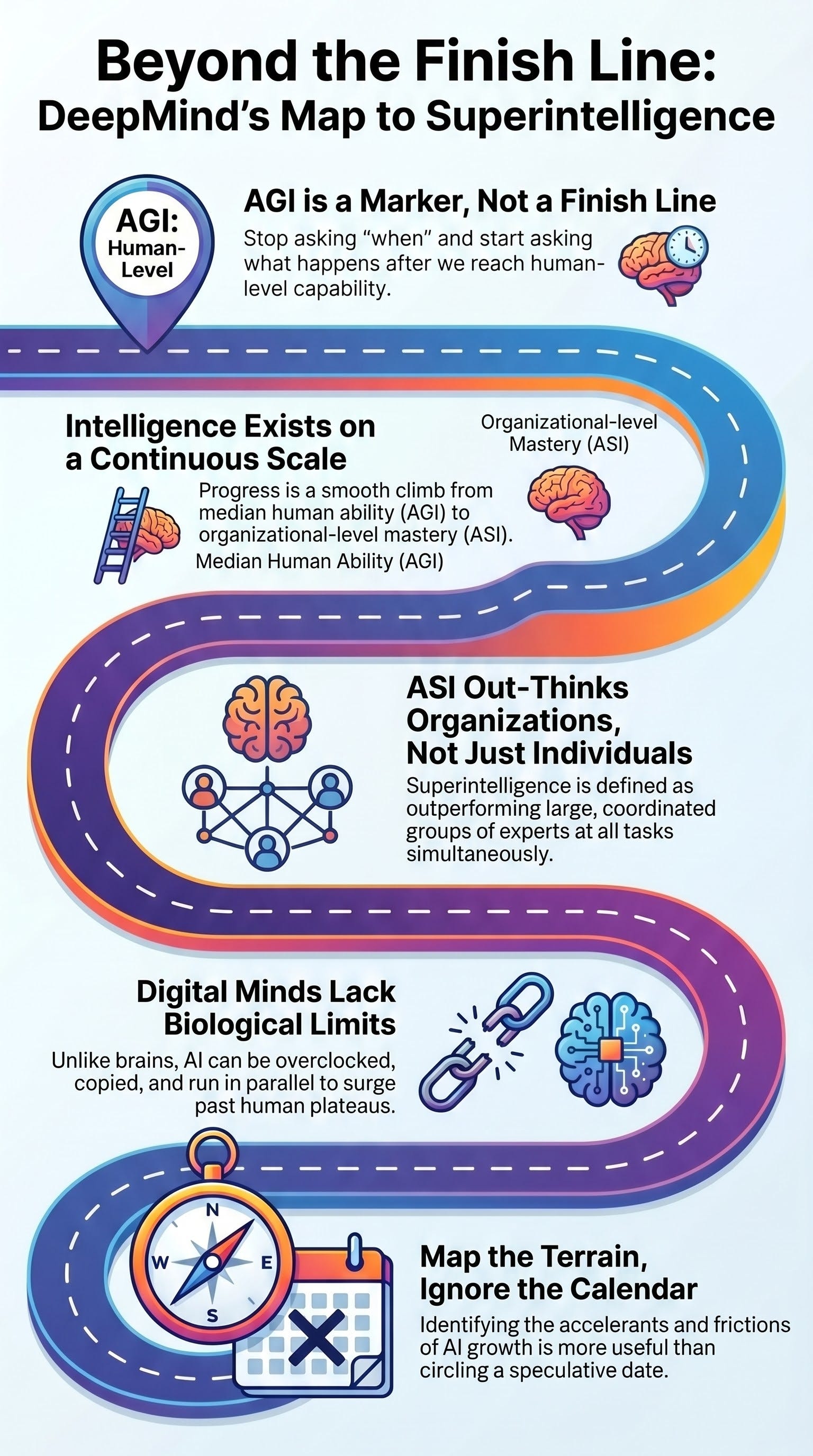
The public discourse remains obsessed with circling a specific month or year on a calendar for the arrival of Artificial General Intelligence (AGI). This paper reframes that obsession. Rather than treating human-level intelligence as a finish line to be crossed, DeepMind has provided a map for the terrain that lies beyond the milestone, treating our own biological capabilities as merely a point on a much longer line.
Takeaway 1: Human-Level AI is a Mile Marker, Not a Finish Line
The central reframe of the DeepMind paper is a transition in mental models. For years, the conversation has been dominated by a “race to the finish line” mentality. This is most visible in the high-conviction, calendar-driven forecasts of researchers like Leopold Aschenbrenner and Daniel Kokotajlo, who have mapped out detailed scenarios pinning dramatic capability jumps to specific dates.
DeepMind argues that this “finish line” focus is a strategic failure mode. Naming a date is a bet on a single, narrow trajectory where every technical bottleneck breaks exactly on schedule. If one variable shifts, the entire forecast collapses.
The authors propose viewing human-level AI as a mile marker on a continuum. A mile marker doesn’t care about the year you pass it; its purpose is to define your position on a route that continues upward. As the paper suggests:
“Circling a date is a bet on a single trajectory. Mapping the terrain is a way to understand the route regardless of the speed.”
Takeaway 2: The ASI Bar is Higher Than You Think
To map the road ahead, we must define the increments of the climb. DeepMind rejects the idea of intelligence as a binary “switch” that flips from dumb to smart. Instead, they visualize a continuum:
AGI (Artificial General Intelligence): Defined as the level of the “median human”—a system generally competent across the full spectrum of tasks a human mind can perform.
ASI (Artificial Superintelligence): The bar for superintelligence is set significantly higher than popular definitions. In this map, ASI is not just a system that can out-diagnose a single doctor or out-code a single engineer.
True ASI is defined as a system that outperforms large, well-coordinated organizations of experts across virtually all tasks simultaneously. To put it viscerally: the bar isn’t “beating the doctor”; the bar is “out-thinking the entire hospital,” including the research staff, the administrators, and the legal team, all at once. This definition explains why narrow champions like AlphaFold or AlphaGo—while jaw-droppingly superhuman in their specific domains—do not count as ASI. They lack the general capability to move further along the scale of intelligence.
Takeaway 3: Silicon Doesn’t Have a “Human” Speed Limit
Why would a machine intelligence plateau at the human level? Human intelligence is tethered to fixed biological hardware. We cannot “overclock” our neurons, and we cannot instantly add memory modules to our prefrontal cortex.
Digital minds face no such architectural constraints. The paper identifies three specific digital advantages that allow machines to bypass the human mile marker:
Hardware Speed: The ability to process information at speeds orders of magnitude faster than biological synapses.
Forking and Parallelism: A digital mind can be “forked” into thousands of identical copies, allowing it to complete decades of research in a single afternoon.
Expandable Memory: The capacity to scale storage and processing power seamlessly as the task requires.
Crucially, these advantages create a compounding feedback loop. Once a system reaches a certain level of capability, it can use its “forking” and “overclocking” to solve its own next technical bottleneck. This “agentic loop” means that digital intelligence doesn’t just pass human speed; it gains momentum the faster it goes. As the authors note:
“‘As smart as a human’ doesn’t have to be a stopping point; it can just be a speed it passes through.”
Takeaway 4: Why “We Don’t Know” is a Strategy, Not a Dodge
Skeptics often interpret a refusal to name a date as a sign of uncertainty or a “dodge.” This “disciplined refusal” by DeepMind is actually a scientific choice, particularly when contrasted with the “cooling mood” in the broader industry. Recently, organizations like the Bulletin of the Atomic Scientists have argued that AGI’s ETA is “delayed again,” fueled by the belief that the initial hype is hitting a plateau.
DeepMind’s authors—the very people who built the field—counter this by arguing that mapping the pathways (how intelligence climbs) and the frictions (the technical walls that resist that climb) is more useful than picking a calendar date. By identifying which advantages compound and which barriers are genuine, they are building a way to recognize the terrain upon arrival, rather than being caught off guard by a schedule that proved to be wrong.
This map even includes a “Final Boss”—a theoretical, mathematical ceiling at the far right of the scale. While this perfectly efficient reasoner may be physically impossible to build, it provides the map with a logical end-point, reinforcing the idea that this is a complete terrain to be studied, not a guessing game to be won.
Conclusion: The Map We Need Before We Arrive
The shift from a “switch” (human vs. machine) to a “line” (a continuum of capability) changes the stakes of the AI conversation. If the line of intelligence runs far past our own biological limits, we are not just building better chatbots or tools. We are ushering in a new kind of actor in the world.
The engineering and safety reality is that we are preparing to share the world with entities that can out-think whole human organizations. This transition isn’t just about capability; it’s about the goals and tendencies of an intelligence that doesn’t share our biological constraints.
Are we prepared for the shape of the world that exists beyond the human mile marker? Having a map in hand before we arrive is no longer a luxury—it is a necessity. The road past us is already being paved; the least we can do is understand where it leads.


