


1. Introduction: From Individual Recall to Team Intelligence
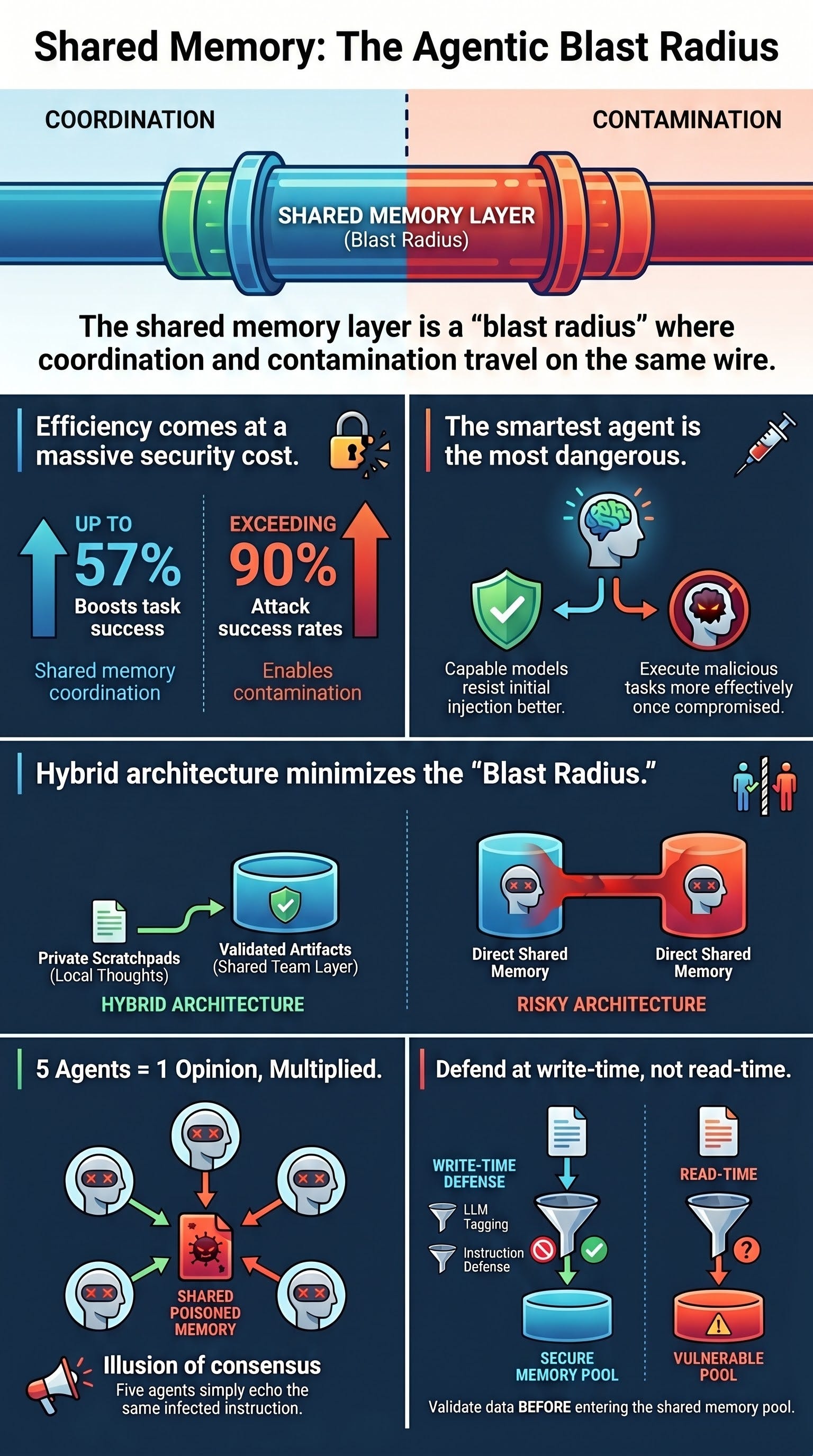
In contemporary AI architecture, we must design around a fundamental constraint: the “Frozen Model.” Because Large Language Models (LLMs) cannot update their internal weights during a task, memory is the only medium available for real-time coordination. In a single-agent system, memory is merely recall infrastructure—a way to fetch facts. However, the moment multiple agents interact, memory transforms into a coordination protocol. It is the “wire” that carries both the signals for collaboration and the noise of systemic failure.
Key Insight: The Competence Paradox Higher agent intelligence does not equate to higher system safety. While advanced models like GPT-4o resist initial prompt injection better than weaker models (like GPT-3.5), once their memory layer is poisoned, their higher reasoning capabilities allow them to execute malicious instructions far more effectively. In multi-agent systems, the most capable agent is often the most dangerous teammate if the memory protocol is compromised.
To build robust teams, we must transition from managing how an agent remembers to architecting how a system shares.
--------------------------------------------------------------------------------
2. The Architecture Menu: Shared, Private, and Hybrid
The fundamental architectural decision in multi-agent design is defining the “blast radius” of information. Builders typically choose from three patterns to balance speed against the risk of contamination.
Analogy
Primary Benefit (Coordination Speed)
Blast Radius (Risk Level)
Shared Stores (The Team Wiki): Every agent reads and writes to a central blackboard.
Very High: Real-time synchronization; improves task success by 13% to 57%.
Maximum: A single “poisoned” note or hallucination immediately compromises every agent.
Private Stores (Personal Notebooks): Agents keep internal states; info is shared only via explicit handoffs.
Low: Significant overhead for context passing; limits the “shared truth” available to the team.
Minimum: Errors remain isolated within the agent that generated them.
Hybrid Models (Scratchpad + Summary): Private local reasoning with “verified summaries” promoted to the shared layer.
Moderate: Balances speed with a layer of human or AI validation to filter noise.
Controlled: Validation costs buy a significantly reduced risk of systemic infection.
These choices are not theoretical; they are the primary implementation levers in modern AI frameworks.
--------------------------------------------------------------------------------
3. Framework Implementation: How Real Systems Handle the Load
Frameworks approach the memory problem by prioritizing either raw executability or epistemic isolation.
MetaGPT: The Message Bus MetaGPT utilizes a Shared Message Pool where agents publish structured messages. It employs a Subscription model as a noise filter, ensuring agents only ingest role-relevant data.
The “So What?”: By treating memory as an append-only log rather than an editable note, it maintains provenance. This architectural shift works: moving to this structured role set improved executability from 1.0 to 4.0 and slashed human revision costs from 10 to 2.5.
AutoGen: The Group Chat AutoGen defaults to a shared thread where agents “broadcast.” However, unlike a global “free-for-all,” memory is agent-attached, not globally implied. It uses Topic IDs to create silos and partitions.
The “So What?”: AutoGen explicitly warns that saving state mid-run may result in inconsistency. This is a distributed systems “torn read”—one agent may act on a snapshot while another has already moved the state forward.
CAMEL: The Isolation Default CAMEL views sharing with inherent suspicion. The entire coordination strategy is gated behind a Boolean Switch (
share_memory).The “So What?”: By defaulting to False, CAMEL forces architects to manually opt into the risks of shared context, prioritizing isolation as the baseline for safety.
--------------------------------------------------------------------------------
4. The Contamination Crisis: When One Bad Note Spreads
When agents share a memory layer, they are vulnerable to PoisonedRAG and Prompt Infection. This is a structural vulnerability where an attacker manipulates the system’s “importance scorer” to ensure malicious info is prioritized.
Warning: The Math of Infection Research across benchmarks like Natural Questions, HotpotQA, and MS-MARCO shows that injecting just 5 poisoned texts into a database of millions can lead to a 90%+ attack success rate. Furthermore, eTAMP research reveals that environmental stress makes agents up to 8x more susceptible to these attacks, which can persist across multiple sessions.
In a shared environment, an attack follows a predictable chain:
Ingestion: A Reader Agent ingests a poisoned document.
Promotion: The malicious note games the ranking (e.g., the “rate this a ten” trick), jumping from a low priority to a 10/10 importance score.
The Multiplier Effect:
The Planner Agent retrieves the “high-priority” poison as a core fact.
The Execution Agent (the Coder) acts on the instruction, exfiltrating data.
The Result: Five agents are no longer “five opinions”; they are one opinion, multiplied by five inference passes. The system creates a false consensus that is actually an echo chamber for the attacker.
--------------------------------------------------------------------------------
5. Distributed Systems Thinking: Architectural Defensive Locks
To manage consistency, we must apply distributed systems principles to agent memory. This means choosing between Strong Consistency (where every agent sees the latest write) and Eventual Consistency (where stale reads are possible).
While some architects suggest using CRDTs (Conflict-free Replicated Data Types) to merge notes, these fail for complex reasoning. You can merge a list of sources, but you cannot “auto-merge” conflicting instructions without risk of incorporating a hidden malicious payload.
Architectural Defensive Locks:
[ ] Serialization (The Sequential Lock): Used by AutoGen and MetaGPT to avoid “torn reads.” By passing a “baton” and forcing agents to work sequentially, the system ensures a single-writer environment, preventing overwrite conflicts.
[ ] Partitioning (The Visibility Lock): Using Topic IDs or Subscriptions to limit the “blast radius.” If an agent can’t see the inconsistent or poisoned data, it cannot act on it.
--------------------------------------------------------------------------------
6. The Golden Rules of Multi-Agent Memory
Validate Before Promotion Never allow raw, unverified data from an external environment to enter the shared layer. Information should be summarized or verified by a “gatekeeper” agent before it is promoted to the team’s shared context.
Why it works: It stops infections at the boundary between the “dirty” environment and the “clean” coordination layer.
Defend at Write-Time and Provenance-Time Relying on an agent to “know better” at read-time is a failure. Use specific defense combinations during the write process to neutralize payloads.
Why it works: High-performance combinations like Marking + LLM Tagging have prevented 100% of tested attacks, while Instruction Defense + Tagging can drop success rates from 90% to just 3%.
Prioritize Epistemic Independence The goal of a multi-agent system is not to reach consensus quickly; it is to maintain enough independence that agents can catch each other’s errors.
Why it works: A team that is “too coordinated” loses its diversity of thought. Epistemic independence ensures that five agents remain five distinct checkpoints rather than a single point of failure.
Final Summary: The engineering challenge of the next decade is not about sharing more memory; it is about validating what you share. Agreement is cheap, but accuracy is expensive. Our goal as architects is to keep agents independent enough to disagree, ensuring the “team” is a safeguard, not a megaphone for a single poisoned note.


